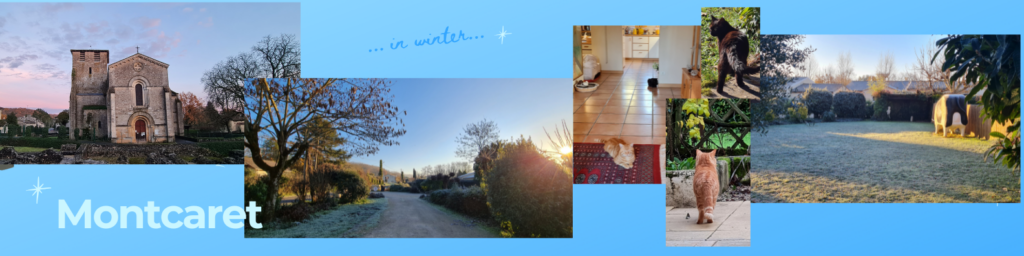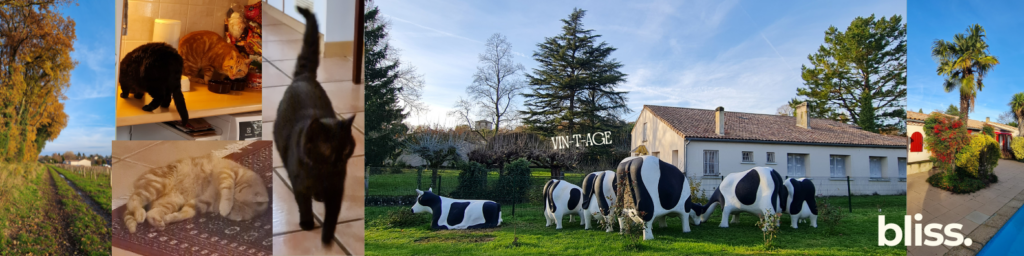
It’s half past nine and minus six degrees outside, as promised by my mobile app. I’ve fed the cats and they are now resting on the floor across the room – big and furry Muphasa on the carpet and delicate feathery Ushi on the warm tiles.
The silence is complete – apart from the ticking of the traditional Dutch clock on the wall which is not unlike a cuckoo clock in shape, but thankfully less noisy and much more intricate in design.
Even the inner dialogue that spilled over from the realm of dreams into my morning haze is finally ebbing down.
What remains is the gratitude for this brilliantly sunny day, how I can go out and take pictures from the frost-covered gravel, leaves and grass knowing I can return to a cozy home and simply relish being where and who I am right now.
For two years I had nourished the dream of traveling but almost gave up on it as the mountain of my family’s belongings I had to work through stratum by stratum appeared infinite and I was so weak that for half a year I experienced one bout of sinusitis after the other. When the tax office knocked on my door assigning an absolutely disproportionate value to my parents’ house from which they would calculate the inheritance tax I was forced to sell it, which turned out to be the best thing I’ve ever done. Now I am finally allowing myself the freedom to travel again, currently as a house sitter. This allows me to get to know different places with deeper cultural immersion than I would have as a mere tourist while having the rent covered in that I get to live for free in exchange for taking care of the pets and plants in the house (and occasionally the garden), plus I can get a feel for where how I would like to live, experiencing different countries and houses. At the same time, I am free in my work as I only need wifi to give my lessons, sessions and work on my texts. I love being able to fit my schedule around the needs of my sweet charges.
Now I have lived and worked in many places around the world, among others, in Moscow, but the sale of my parents’ house gives me the financial freedom to temporarily only take on the jobs I like and to truly explore new avenues.
It has taken me quite a while to get to this point, since for over a decade I had worked in a schedule that most of the weeks wouldn’t even allow for half a day off – and by week I mean 7 days – since the most work-intensive times would be weekends and nights. In a way, I thrived and was surprised and proud I could make it, but using every free moment – even while traveling, sitting at the hairdresser’s, or taking my breaks in between classes – for translating (which became almost a pastime…) – had alienated me from having normal interactions with people. Any conversation would need to have a purpose as it was to either exchange work-related information or have the form of a session… and while these sessions admittedly would also leave room to simply vent and get one’s emotional needs met, the framing was always result-oriented and hardly ever spontaneous. Phone calls with friends and family had to be meticulously planned and fit into my overflowing schedule, and most of the time they felt like yet another appointment I had to muster the energy for instead of just taking a rest.
Now I would be lying if I said I didn’t like it.
Having a rather introvert nature I was happy with this setting that allowed for “no-nonsense” interactions that “served a dedicated purpose”. Yet over time, the nagging feeling grew that the purpose was not being achieved – which purportedly was to become free of limiting beliefs and create one’s life as if no relationships, even the ones with friends and family, truly mattered. This became painfully clear to me during the 6 years in which I accompanied first my father, then my mother, and finally my sister during their last months and weeks.
On the one hand, my self-employed status made it possible for me to be there for them in a way I couldn’t have been had I had a “regular” job and a family. Apart from that, a certain detachment resulting from this “session-oriented” mindset also helped me be stronger throughout the whole care-taking process. On the other hand, to put it bluntly, the fact that it took my family to die for me to choose to be fully there for them, had a bittersweet aftertaste.
Now that all of them are gone, for good, and after I’ve taken the time to see them off by taking every piece that belonged to them into my hands and bidding it farewell, this new space has opened up in which I am left to my own devices in choosing – for the first time truly unencumbered – where, how and with whom I would like to live.
The whole process has shown me that I’ve outgrown the session-framed lifestyle. Currently I even experience a slight aversion to the concept of one person meddling about in another person’s soul and emotional landscape, especially when they haven’t been asked to do so. Ironically, I now find people seeking me out for sessions organically – and this is where I like the sessions to remain from now on: within a clearly agreed-upon time and space. What this process has also taught me is that not all friendships I used to have stood the test of time. Apparently, some of them were just temporary alliances born out of my main occupation during that period. I am grateful for this, and even more grateful for learning to simply be myself – different in each moment – without the unspoken mandate of constantly having to improve. I relish how I am being received by people, especially here in this special enclave of open-minded people from all over the world.
Of course, my current life choices are sometimes met with conclusions due to a lack of understanding how working nomads live (and earn money! :-)), but all in all, what counts and sticks with people is the energy we emanate. So I am making new friends along the way, and first and foremost, I am making friends with myself, with my body, with my needs in respect to all areas of life.
That is an immeasurable gift. Something I’ve dreamed of all of my life – to be able to be alone and with people without discomfort or second-guessing myself all the time.
So I am sharing with you, dear reader, the peace from my current residence – within and without – still with the ticking clock in the background, but the cats long gone out into the sunshine to explore this beautiful day.
Yesterday while cleaning, I listened to a short piece about ADHD and for the first time felt directly addressed. It was as if the authors had heard my questions from the past few days and answered them specifically.
I should preface this by saying that I’ve become increasingly skeptical of the inflationary use and attribution of diagnoses—including, by the way, of narcissism, which, of course, is generally projected onto others. It’s like everybody is freely using these terms to explain why they struggle to keep order, concentrate, or keep appointments. Statistically speaking, it seems unlikely that so many people “have ADHD”—though of course, increased awareness makes the number of “diagnosed” individuals appear to have suddenly risen. However, when I watch content featuring people who really have ADHD or autism—often incorrectly used synonymously—I must admit they truly function differently. To deny them their uniqueness and yes, their struggle in a society where this isn’t yet considered part of the norm, by conveniently attributing certain quirks to an amorphous complex of “symptoms,” I find inappropriate and even unfair.
Having said that, with this particular piece, I experienced not just an abstract recognition of often-heard information, but felt directly addressed.
Just days before, in a dejected mood, I had written down everything my “inner critic” says (an exercise that can be very helpful, but more on that another time), and terms like “antisocial,” “unsociable,” “poorly connected with other people” particularly stood out.
While I’ve since acknowledged that my way of connecting might not always manifest in physical togetherness, I’ve repeatedly wondered why I find it so pleasant to spend a lot of time “alone”—to say nothing of the fact that during this time I’m not alone at all! Rather, I think about others and play through various scenarios, trying to recognize and understand the energy behind them.
The dynamics in large groups, however, quickly tire me out, because even when I really like people individually, I often struggle to bear their behavior in large settings. And I mean that more in the sense of being perplexed and surprised rather than “how could they?”
The piece explained that a brain with ADHD functions differently from other people’s on average: While their brains release dopamine when they’re in large groups—making them feel great, energized, and uplifted—the exact opposite happens with an ADHD brain: It releases less dopamine while simultaneously being exposed to sensory overload, because its extremely fine antennae perceive everyone’s varied moods like an enormous, incompatible weather system descending upon them. Nothing makes sense, especially the masks that inevitably come out in such settings. Thus, the mind tires quickly, and you are left to wonder why you’re so bad at this social game, so “unsociable.”
I felt so validated!
Large crowds can bring me joy, but usually from a distance. In books, films, or in passing, I find it wonderful to see many people come together, but for myself, I much prefer moments just before opening or closing time in shops, night shifts when almost no one is there, situations where few people use facilities designed for large crowds and everyone (in my perception) can be completely themselves. Immersing myself in large crowds appeals to me on the condition that everyone at least temporarily shares a common goal—like in a course, in a choir, at an airport or train station, or in an exceptional situation.
Interestingly, I find it relatively easy to speak in front of a large group of people—the larger, meaning the more anonymous, the better—though I attribute this to the fact that I then practically have a sanctioned task and can act purposefully.
Small talk for small talk’s sake, however, confuses me to this day.
How can we pretend not to see beyond the second or third mask?
And I admit that I may never have understood the rules—again: not from refusal, but from inability.
This is also what I love about traveling to different countries—seeing how different societies deal with closeness and truly seeing the other person.
So far, I’ve felt most “at home” in Russia and with people from the “Russian-speaking” sphere of influence, where there are fewer unspoken laws—or perhaps the existing laws are intuitively more familiar to me? In any case, interactions are generally more direct and less governed by codes. For someone like me who takes things very literally because I try to be as honest as possible, this is very refreshing—the guessing game falls away.
This direct approach seems in turn to stimulate people’s ability to see behind masks. I was amazed by a former Russian lover’s comment, who was loud and jovial among his colleagues, about my sometimes complicated emotional maneuvers: these are trifles, that’s just character. Similarly, a Georgian friend commented on a mutual acquaintance who was a (very charming) cheat, saying he was unreliable and sometimes a bastard, but had a heart of gold.
And both statements came without the slightest charge, more like noting someone has brown eyes and likes ice-cream.
Up until then, I had only encountered such nuanced perceptions of people in books that describe people in their entirety.
Perhaps that’s my great longing—to have casual conversations about what I consider essential: what each of us truly is about and moves us right now.
This is where I’m endlessly grateful for my wonderful friends with whom I can have such conversations!
But everything in its time, in the rhythm of closeness and distance that suits me. 🙂
It’s curious, isn’t it, that I still haven’t determined whether the ADHD label applies to me, or to what extent. But that’s not really the point here, or rather, the point is that it’s not about the labeling.
Ultimately, it’s about all of us being seen in our entirety and uniqueness—and to find recognition like I did in this piece often feels good.
In the end, however, it always comes down to how we treat ourselves.
As long as I listen ever more kindly to my needs and don’t dismiss them as abnormal, but rather see them as my particular way of processing stimuli that can manifest in various ways, I can simply let them be.
I don’t need to classify them as good or bad, appropriate or inappropriate, ordinary or special—they simply are.
How about you?
What kind of closeness is important to you, how much and with whom?
How much time do you like to have in between to “digest” impressions, to sort things out?
If we didn’t have to assign ourselves lofty labels to justify our difference, how kindly could we simply choose what personally suits us in each moment?
What if ALL variations are cool, simply because they exist?
A man who loved his wife above all, was happy in and with his job and, together with his beloved, enjoyed life to the fullest!
What I was allowed to learn from my few but all the more illuminating conversations with this remarkable man are not only the details of his life – which astounded me by the ease with which it unfolded, and how one thing led to the other – but the pervasive sense of peace, gratitude and benevolence he exudes.
It’s like his universe is so rich and full there is no room for pettiness or suspicion, nor does he appear helpless or needy even though his situation calls for some outside help.
I was introduced to Doug by Liz who has been seeing him every week ever since his beloved wife passed away only two months ago. As their children live in the UK and he is staying in the house the couple had shared in the Dordogne for over 20 years, there are just a few people who can check on him in person.
But when I first met him, he seemed content and cheerful enough. “Taking over” Liz’s weekly visits while she is away, and after some initial apprehension – would we have enough things to talk about, would he be able to hear me well as he needs a hearing aid? – I must say it is a privilege to go see him and talk to him. Where my father, who was also hard of hearing when he grew older, got frustrated with me and the situation, Doug has the patience to let communication happen with ease. And as usual when talking to someone from a totally different background our conversations got me to question some of the core beliefs I just had adopted from my family.
You see, my father had also seen the war as a child, and when his poverty cut short his study of medicine, he became a soldier – with the explicit intention of keeping harm at bay so there would not be any further military conflicts. Today, I was astounded to learn from Doug about 3 ongoing wars during the time of his conscription – Malaysia, Korea, and Kenya – his country was engaged in which fortunately he was not forced to join, whereas as long as my Dad was alive, he never even came close to a combat situation, despite of him being a professional soldier.
Maybe it needs mentioning here that Doug and my Dad are only 3 years apart. Where Doug was totally against the military – while still choosing to see his two years of service as a chance to broaden his horizon – my Dad was for it, but as a means to an end which was peace – an equilibrium of forces that would foreclose a development like the one in the 1930ies.
Had my Dad had his way, he would have become a physician, not unlike D who became a vet, and both of them share a love for history and a benevolent attitude toward people – but here the similarities end. However, I don’t want my little text to become a comparison with my beloved Dad, but just remain an amazed testimony.
Doug was happy knowing many people and would entertain the guests at the dinner table even when he came home late from work because he had taken on a late surgery. He and his wife liked traveling and would pack their car on a Friday night to ride several hours down to the coast to spend the weekend with their good friends, only to make the trip back up on Sunday night. When a manor fell to them, they thought about how to make the best use of it so they invited bridge and arts teachers to offer free classes to whoever was interested. The guests would stay in for days while being entertained by Pam who had taken to cooking after learning it from her husband.
After his retirement they made a lifelong dream come true and moved to Montcaret which they had so far only visited for holidays. With Pam knowing French very well this seemed like a no-brainer, and they truly and thoroughly enjoyed their life. Doug, a little less well-versed in French, would still join a local bridge club where the Polish teacher would require participants to practice at home in between meetings. This way, the group got so stay at a different house each time, and, much to Doug’s amusement, they would call him ‘the professor’. Apparently, he got a knack for it.
Pam and himself would go on cruises and see all kinds of places, and later, when they had already done all the excursions, they’d have the deck to themselves and leisurely sip on their drinks.
They’d keep each other sharp by doing crossword battles every day, and not shy away from correcting each other, but never in the spirit of competition but always lovingly.
So it is no wonder I find him in good spirits, making it a pleasure to spend time with him and talk about all kinds of things.
Looking forward to more conversations, and to sharing my first Christmas lunch – on the 25th of December, with Doug!
After a deliciously slow journey that allowed me to enjoy all the carefully selected stops along the way without any stress, I arrived at my first official house-sit—caring for two whiskered companions—on December 1st at exactly 5 PM. My host Liz attributed this to German punctuality (ha!), though honestly, I had simply planned an extra-generous time buffer.
The welcome was warm and overwhelming, and the three days until Liz and her husband Henk’s departure continued in much the same way—from morning till night, there were fascinating briefings, many new faces, and an endless stream of new impressions.
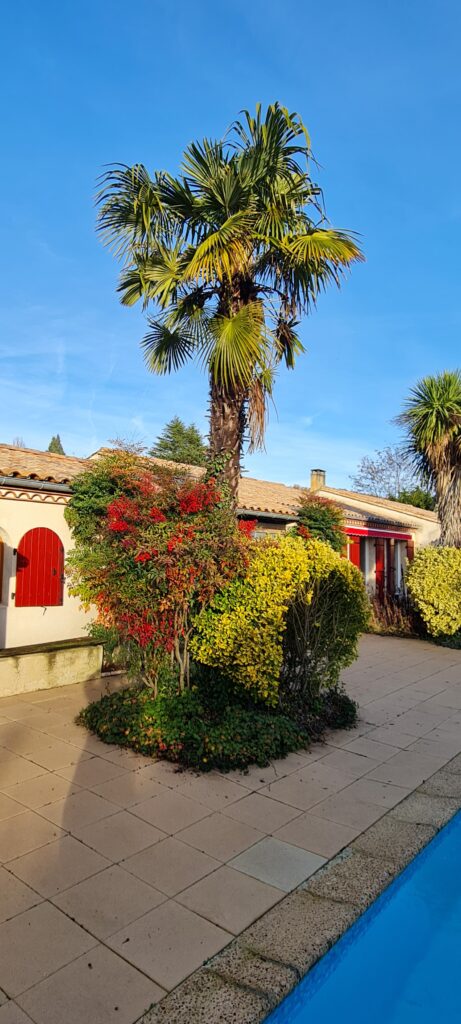
Liz and her husband Henk have created a wonderful little “village within a village” in the picturesque Dordogne, complete with professionally equipped houses—it’s called VIN-T-AGE and is designed for people 55 and over who enjoy independent living while also appreciating a relaxed community. The tastefully designed and modernly renovated houses are home to interesting people from all over the world.
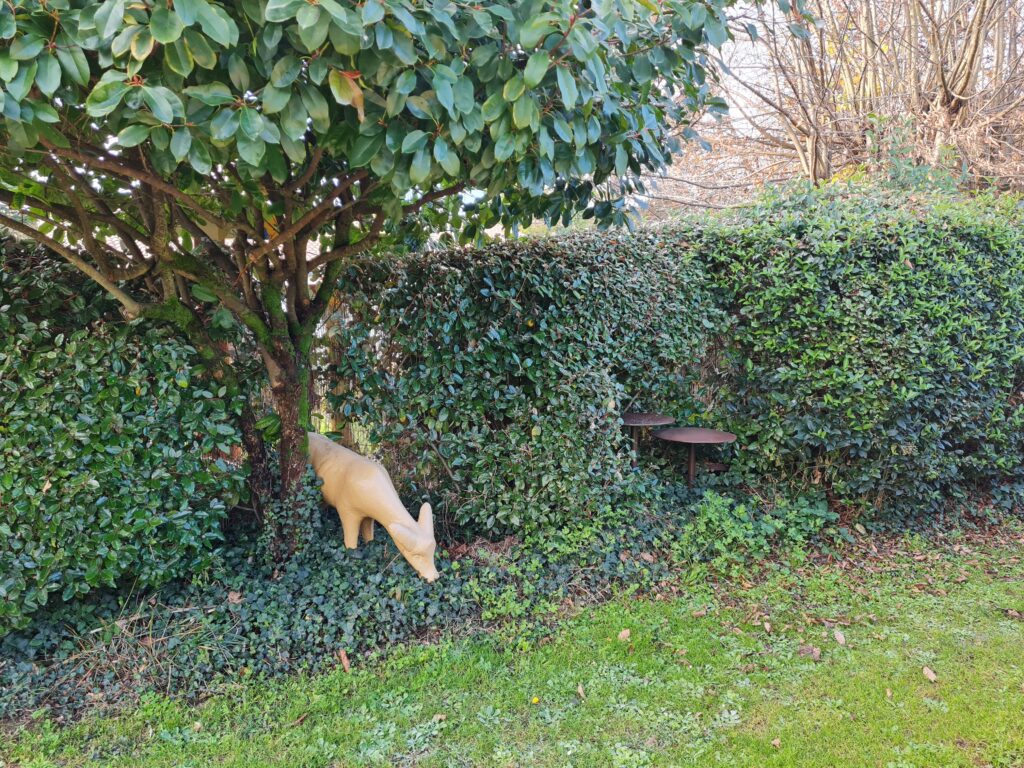
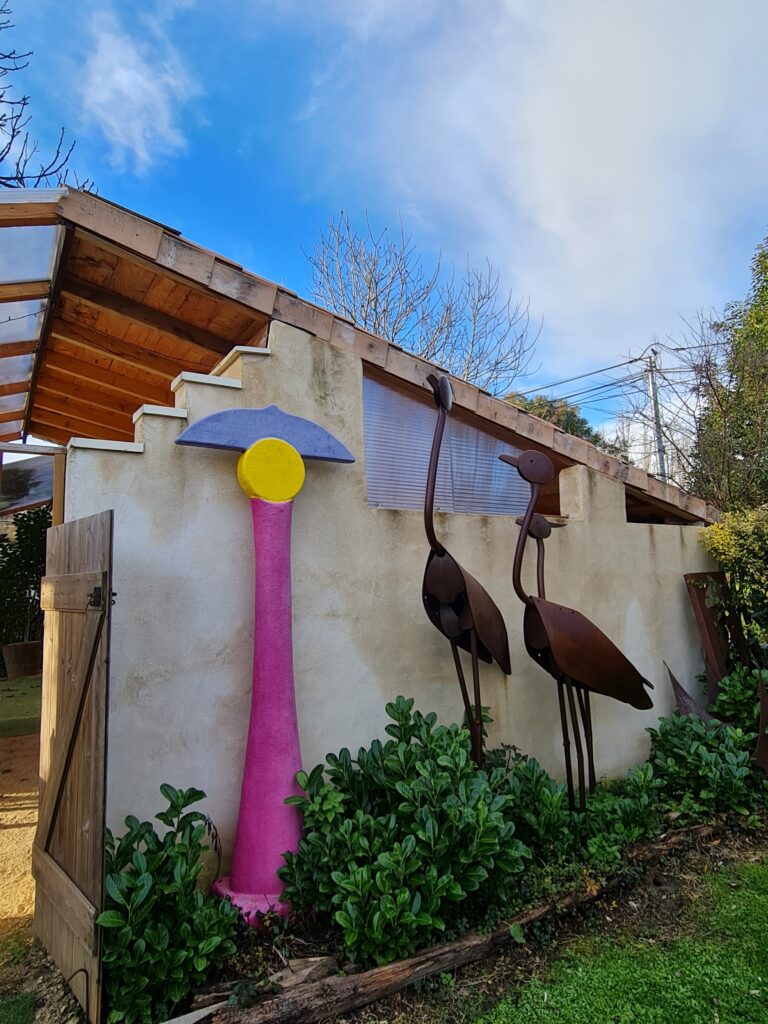
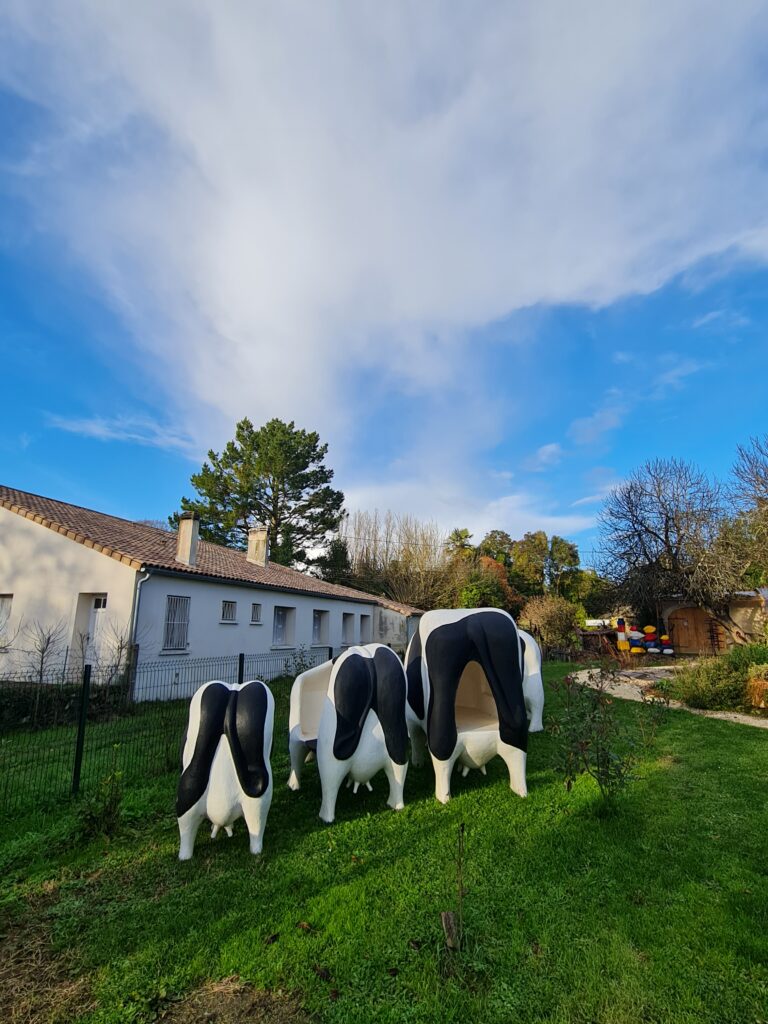
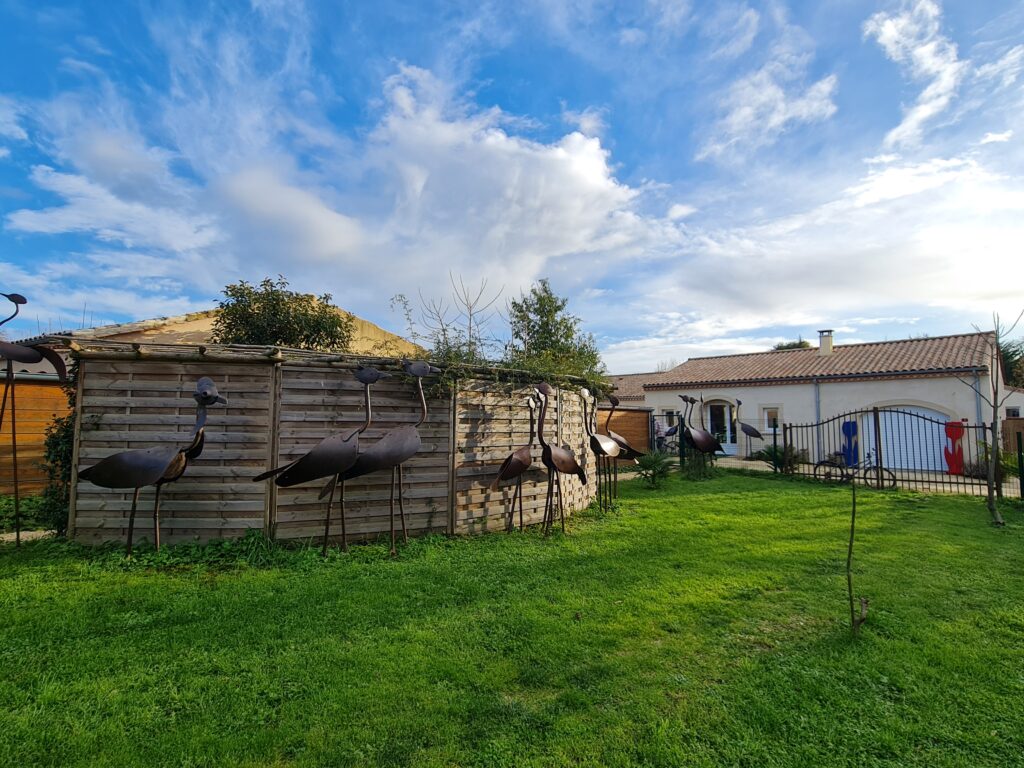
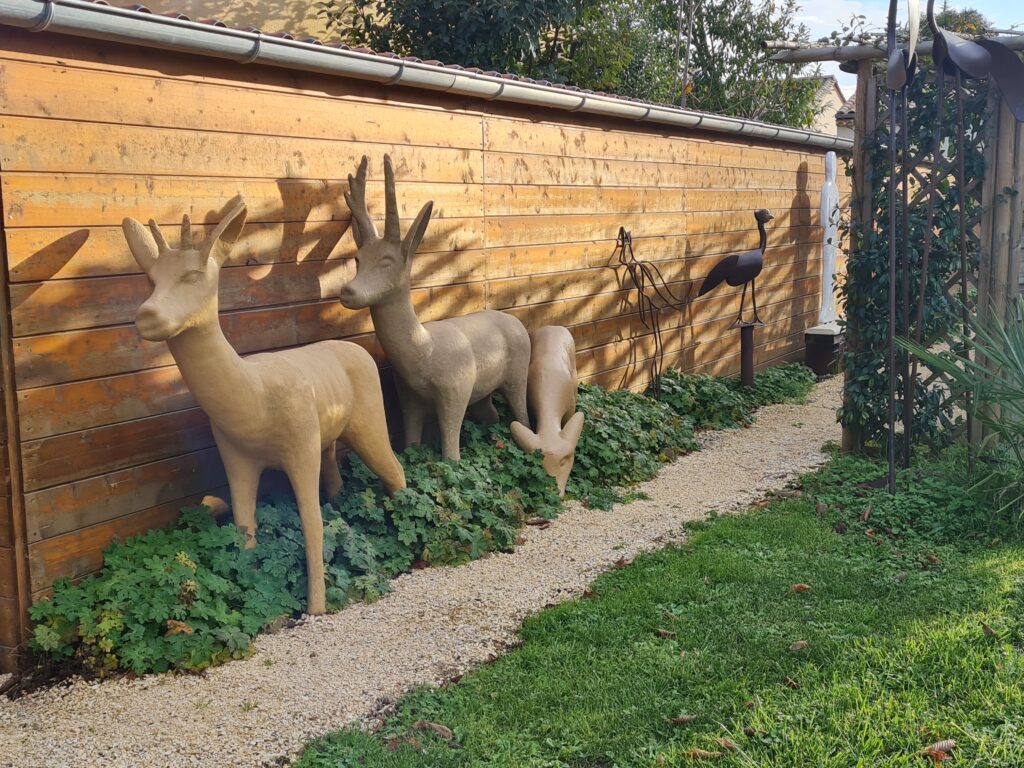
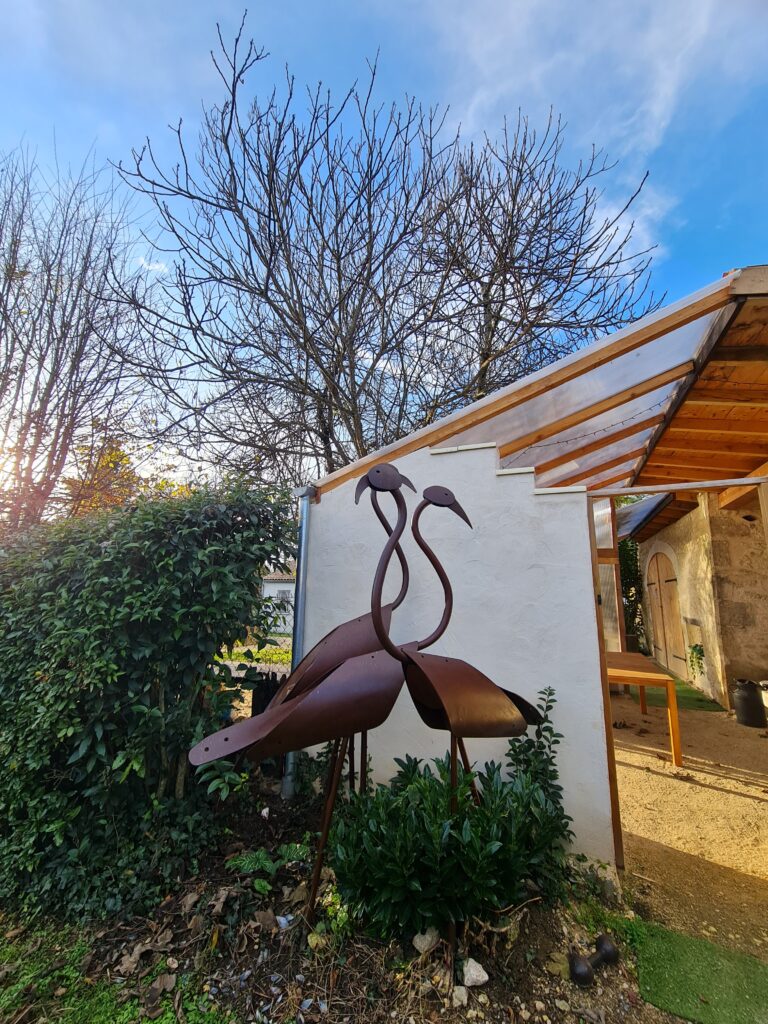
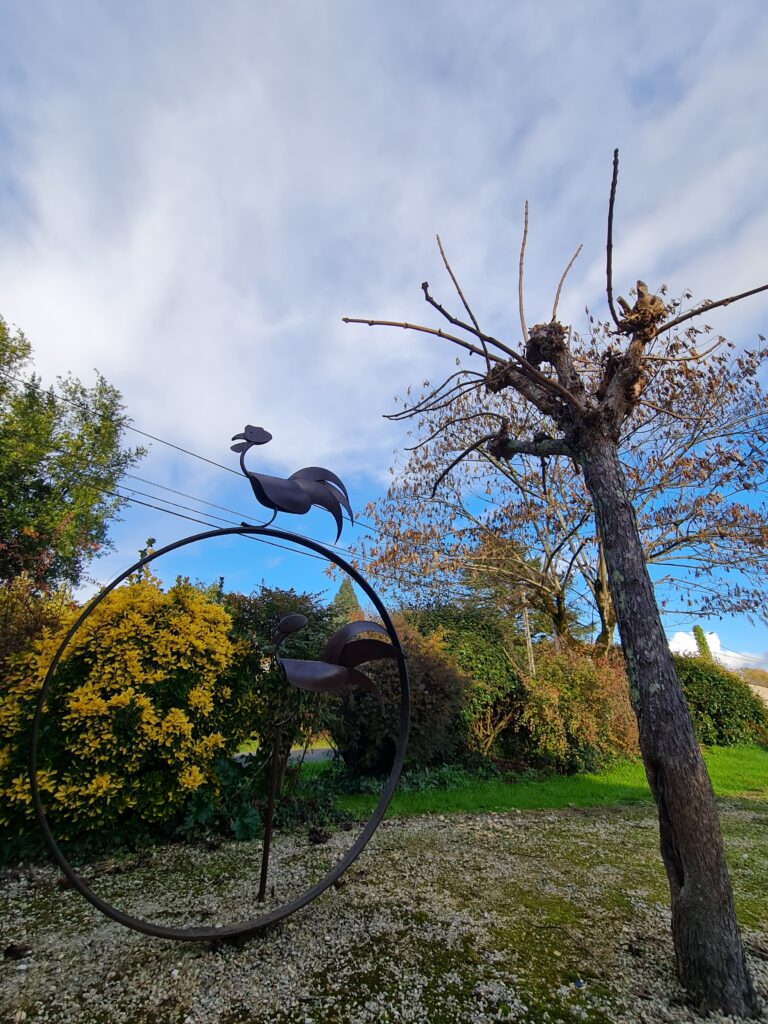
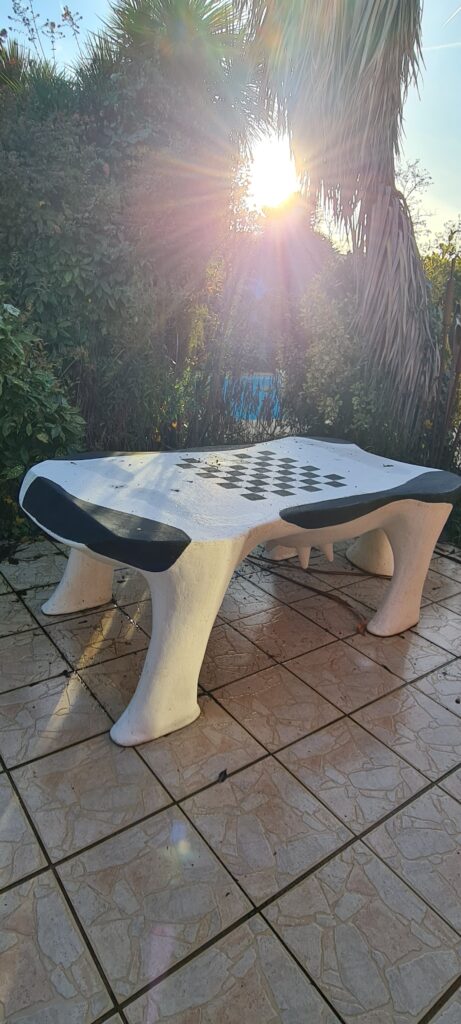
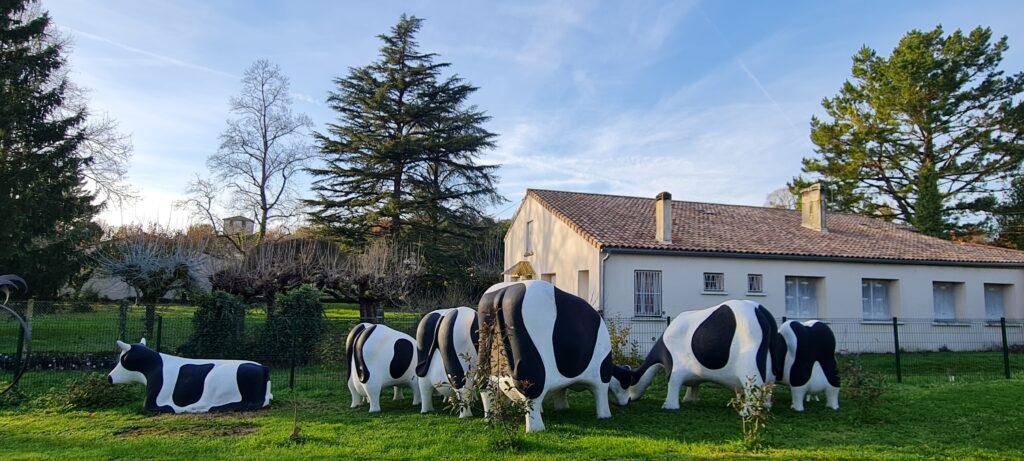
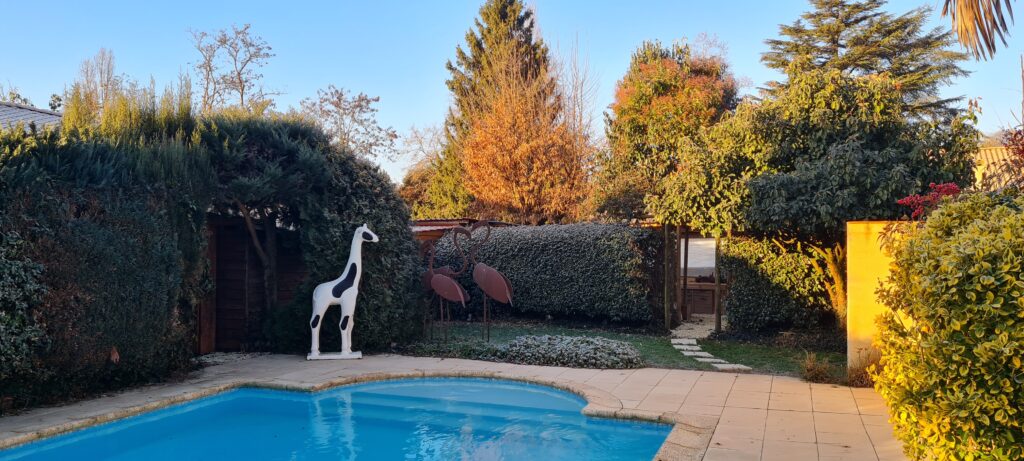
This circumstance, along with Henk’s many outdoor sculptures throughout the expansive garden, makes this place truly special—harmoniously integrated into Montcaret, a village of 1,200 souls.
Henk constantly works expertly on the newly added houses, maintains the garden and pool, and at his absolutely incredible 75 years, moves so quickly that I could barely keep up when he took me to the town hall once. Even during garden work, when I offered to help, he set such a pace that I almost felt old. 🙂
Liz is the masterful organizer where all threads come together, and she seems to know everyone in the county. Without much fuss, she actively takes care of other people, brings them together, runs the entire project, and manages the household on the side. As if that weren’t enough, she goes to the gym and dance classes several times a week—and cares for ever more cats who seek refuge with her.
Now the two are away on a longer trip, so Ushi and Muphasa, along with house and garden, need someone to care for them for 5 weeks. Thankfully, this task—arranged through an online platform—fell to me!
At first, there was a bit of drama, as Muphasa, the wild tom, mostly fled from me and then made himself quite scarce, which made me rather sad. But Liz explained that he wasn’t used to the bustle in the house with so many people at once and would relax once they had left.
Still, the doubt lingered that there might be something about me that he simply couldn’t stand. In contrast, sweet little cross-eyed Ushi was open and cuddly from the start, tucking her little head into the crook of my arm.
Thank goodness, Liz’s prediction came true—as soon as I was alone with the two of them, Muphasa also visibly thawed, and now I’m allowed to give him thorough scratches too. His relaxation when he lies on the carpet like a plush toy, dreaming with twitching paws, speaks volumes.
After an intense settling-in phase, I too have found my rhythm. Just last weekend, I was relaxed enough to visit the local museum… Yes, it’s hard to believe, but within a 5-minute walk, there’s a Gallo-Roman church and remains of a cemetery, which in turn were built on an expansive Roman villa with thermal baths and cold plunge pools. Today, the site offers a fascinating mix of excavations from widely separated eras—this definitely won’t be my last visit!
This little place is full of surprises, and I’m tremendously looking forward to my first excursions to Bordeaux, which is only 50 minutes away by train!
So far, my daily life consists of garden and pool maintenance, my online sessions, extended walks, and initial contacts with the lovely people here—but the highlight remains feeding and petting these two four-legged friends.
This is where my parents got to know and love each other—he from Recklinghausen, a medical student, she from Nuremberg, studying English and German literature.
They met at a cross-faculty ball, two highly sensitive and life-hungry young people with difficult pasts, and fell head over heels in love.
Finally, there was someone who shared pain, depth, and joie de vivre with the same intensity as they themselves did.
The freedom they experienced here from their previous lives must have been intoxicating.
The gentle and expansive landscape with meadows, forests, water, and mountains, almost in the very south of Germany, student parties and new experiences.
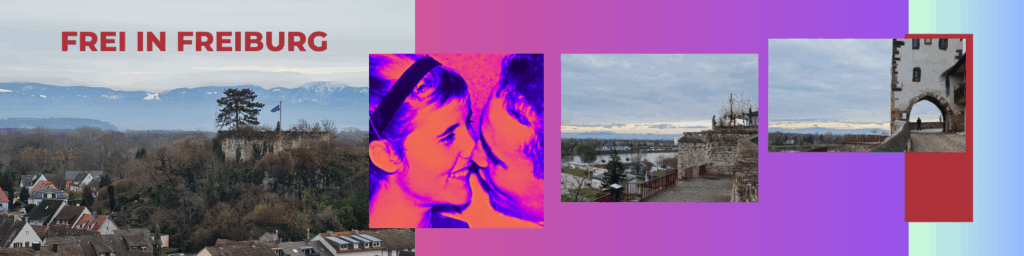
For my first stop on the way to France, I consciously chose Breisach near Freiburg, where my parents apparently once stayed overnight—at least that’s what an old hotel address I found in one of their notebooks suggests. Of course, they wouldn’t have stayed here as students, as they wouldn’t have been able to afford a hotel.
Yet the landscape, the views I was able to capture today despite the cold, hint at how my parents must have enjoyed the special atmosphere and the almost French air here.
I remember how they spoke of their student years:
My mother in a room in the city with a (supposed) ban on male visitors, large bowls for washing, and secret excursions to the bakery—croissants!—and my father renting a room outside Freiburg, so poor that he sometimes had only bread and mustard to eat—and yet enjoyed the freedom of cycling into the city, even if once his eyelashes nearly froze together from the cold.
The few pictures from that time show them carefree at parties, even though they, like everyone else back then, looked more grown-up than later generations.
When my mother went to Paris as an au pair, my father followed her and took a job in a workshop. When he unknowingly tried to fill the gas tank of a French car through the wrong opening, he was nearly fired. And my mother’s host family was so concerned with staying slim that even she—who prided herself her whole life on not caring about food—later enjoyed baguette, cheese, and wine on a park bench with her beloved.
Their stories of the artists by the Seine, of evenings of dancing and jazz concerts in Freiburg, sounded truly wonder-ful, if also nostalgic, like a time that could never return.
I’m grateful to have caught at least a breath of that atmosphere today—and I raise a toast to the absolute freedom my parents have now become!
It’s been a long time since you’ve heard from me—and yet I had planned everything so differently!
After my last post about the exceptional situation of being without internet, I was hit by a cold and then Covid, so I spent the rest of my time in France separated from sweet Loulou, literally shivering in another apartment, hoping for improvement every day.
The only bright spot was my dear friend, who had returned from her trip with the children by then and brought me delicious food and so much compassion and human warmth with her daily visits that I felt better morally, at least.
All the strength I could spare, I directed towards taking care of my most important students and clients. Otherwise, it was a time of tremendous weakness, miserable freezing (even a mattress felt like it was drawing too much warmth from me, so I preferred the sofa), stress-induced sweating, incessant headaches, and restless waiting for improvement, since I never get a fever but instead process all stages of illness agonizingly slowly—on a low flame, so to say.
The only “highlight” was a visit to the doctor, to which my friend accompanied me to interpret if necessary. And lo and behold, even though he spoke at lightning speed, I understood him for the most part! That was a pleasant surprise.
I also unintentionally provided a comical interlude when, after asking my friend in “sign language”, I literally followed his instruction “Tirez la langue” by holding my tongue with one hand and trying to “pull it out”… The doctor, however, remained completely unimpressed and continued bubbling on…
As soon as my condition allowed, I met my friend for walks by the sea, and I also saw my dear Loulou a few more times—according to my friend, she was different after our farewell as well. Her husband later said she probably wasn’t quite satisfied with them anymore after the “Corinna Spa”… Oh, Loulou!
Ever so slowly I crawled back out of my pit, though there were setbacks again and again. On the day of my departure, my friend encouraged me to try once more to apply for a rehabilitation program, which gave me a tremendous moral boost. So although I set off with cold feet and a woozy head, I started feeling better with each passing day—thanks to much shorter travel stages than on the way there and to rediscovering my joy of driving (what a blessing a heated car seat can be!). Contrary to the pattern my mother propagated—to only start when you feel 100 percent well—I discovered I can move forward even at 60 percent, if much slower, mile after mile.
Arriving in Germany, my family doctor confirmed that I had had Corona and immediately gave me remedies for all the other infections that were still weakening my body. Since then, the intense freezing and tendency toward colds have continued, which partly clouded the overnight stays with my friends. And yet I wouldn’t want to miss these encounters!
The loveliest and warmest was with the dear new owners of my parents’ house—both physically and emotionally. They said I wasn’t a guest at all, but part of the family, the family member who had been missing. That’s how I felt too—in their beautifully newly furnished guest room, I felt more comfortable and at home in my parents’ former house than ever before!
Loaded with delicacies—also from my friend before—I set off like a Russian student after a visit to her parents to my next stopover before my departure for France: Stuttgart!
In an inexplicable way, I always feel slightly more comfortable, more alive, more attractive in this city.
This time I picked a good and affordable accommodation that allowed me to make my room exactly as warm as my body requires. (Who knows, maybe my body wants to signal to me that I should look for other climes? ;-)) And I met dear friends and also former colleagues of my sister at my own pace.
It was particularly touching to actually find books of hers in the university library, which I recognized by her signature on the flyleaf or a few handwritten notes. Thus, the 1200 books from her estate have found their way into a worthy corpus of books at her home university and are now available to countless students—just as she would have wanted!
Soon my departure for the first “official” housesit in the Dordogne is coming up—the route with many historical stops is already planned; now I just need to get various seeds and grains that are hard to get by in France, as well as gingerbread for my “hosts”.
I am very grateful for this time, which taught and teaches me to be even more patient with myself and my body. During the numerous official encounters—household insurance, driver’s license registration office, storage facility, police, fiber optic cable provider, bank, tax office, etc.—I increasingly managed to approach everything step by step and not panic.
For decades, I always had to handle all formalities under extreme time pressure alongside never-ending work units and was quickly thrown off track when everything didn’t immediately “flow smoothly”. Now I’m experiencing and learning that everything is solvable and even initially frightening authorities like the tax office and police are also just made up of people to whom you can—what a surprise! ;-)—actually talk!
It also became clear to me that with this reaction I was imitating a pattern of my father’s, who had to shoulder almost everything at home with few exceptions and had already internalized this role as a war child early on. This resulted in a mixture of being overwhelmed by having to solve tasks not appropriate for a child and the frustration of always having to do everything alone—a cocktail that I had apparently energetically absorbed.
Are you also familiar with stumbling blocks like this—when everything tightens up inside you, your breath becomes shallow, and you want to get this one thing behind you as quickly as possible?
Where the sovereign adult you normally are suddenly evaporates and you fall into behaviors and reactions that are rather typical of an overwhelmed child?
If you look at whatever currently lies ahead calmly and from the perspective of the adult you are today—is it really so frightening, or could a calm approach to this thing perhaps open up completely different perspectives?
Right now I’m surprised myself that my post, originally planned as a brief description of my stopover in Germany, is taking this turn. 🙂
But what if this realization alone from the illness-induced slowing down is already one of the gifts I was allowed to take with me—apart from the realization that I can also continue when I’m not one hundred percent healthy?
I’m exercising patience and probably going about everything more slowly, but I’m no longer letting myself be stopped!
In this spirit, I also wish you a little more patience with yourself—with how your body reacts, in uncovering and releasing internalized patterns, in exploring how you react to things TODAY and what would really do you good.
To put it into questions:
How much patience can you have with your body today?
Where are you repeating energetic patterns of your parents (and can simply let them go)?
If you had no preconceived opinion about how you react to what and when—how are you doing RIGHT NOW with ______?
Receiving, Light and Loulou: A Day Without Internet The Joy of Being Alive, Part II
After over 30 hours of shaky connection with countless attempts to fix it, now a complete outage.
Paradoxically, way out by the seashore there’s enough network so that at least the prepared messages to my students can go through.
A good opportunity to write my next blog post.
About my wonderful time here in the south.
About the sun, the light, the vastness.
And now also about the rain, the power outages and internet failures…
Earlier at the sea I took this picture – what a magnificent spectacle!
And at the same time I noticed how much the prospect of having no internet today relaxes me.
How much deeper and calmer I breathe.
How the inner daily structure suddenly loosens its iron grip on my brain.
All of a sudden so much time opens up!
Yet the internet is the world that enables EVERYTHING for me as a digital nomad:
contact with clients, students and friends,
the ability to post on various channels,
my source for news from around the world and entertainment.
Paradoxically, this seems to create a certain pressure, as my body is now showing me by how it feels when the internet is temporarily gone.
The moments become more intense.
My brain – still recovering from a subsiding sinusitis – visibly relaxes.
Time suddenly stretches out infinitely.
My choices become so much bigger.
And I feel transported back to times when this constant entertainment and communication unit small enough to fit in our handbags didn’t exist:
When the height of technology as a child was arranging to meet friends on a rotary dial telephone – if we hadn’t already done so at school – and I knew all the four-digit phone numbers by heart!
When as a student on the endlessly long train journeys to Russia, which I made possible again and again through jobs and strict saving, I listened to the same blues cassette up and down on my Walkman – mind you, not on automatic loop, but I had to take out the cassette, flip it over and press play again… ;-).
When later as a DAAD tutor in Russia I could only write emails to my family once a week in the university computer lab, which depending on the stability of the connection would either go through at the end of the session, or not. And this was the only communication for 9 months, as phoning was too expensive.
How did I experience all this?
According to my body’s reaction, which immediately becomes completely calm and breathes freely, as free and light and “fully there”.
Today there’s so much talk about mindfulness, about being in the moment, in the here and now, being present. Techniques are offered and extensively discussed on how best to achieve this state.
Sometimes, however, being present becomes yet another goal to be achieved, to which we only give space during certain time slots, like during yoga, a nice bath or a walk in nature.
In advertising there are more allusions to presence-promising breaks than ever before: whether it’s about tea, a car or Kinder Pingui.
While constantly being online is indeed identified as a risk factor that counteracts presence, something else is lived and practiced.
The diverse offerings of the colorful online world are all too tempting and simultaneously create a certain pressure.
At least I feel unsettled by the symbols of unread messages, while “checking them off” satisfies my reward center. But the next time I reach for my phone, I’m already looking for the next notifications.
Escaping all of this seems like a hopeless battle.
But what if being present were easier than we let ourselves believe?
What if we simply allowed ourselves, without any further judgment or consideration, to just be as we are right now?
And permit ourselves to perceive our own feelings and let them “flow through” us, without distinguishing between supposedly good or bad sensations?
What would it be like to no longer have to set aside special time periods for “being present”?
When I’m fully in the moment while washing dishes, while having a difficult conversation with a client, or while eating, I no longer need special rituals.
I might even be more efficient if I’m not already thinking 10 steps ahead, and above all, I’ve then fully exhausted each moment, experienced it so deeply, that I no longer need to return to it.
Of course, there are moments so intense that the mind wants to shut down. Then a later reflection on what happened may certainly be important.
As someone who unfortunately used to do this excessively – when my mind started mulling over the events of the previous day as soon as I woke up – I’m very grateful, however, to have now found a different approach: namely to experience things right now and then move on.
For all moments that can be processed by just being “there”, it’s now enough for me to simply experience them fully and completely, in order to then consciously shape the next moments from this being.
An example:
I have an unpleasant conversation with a client. By being fully “there”, I feel and recognize where it’s stuck, what’s tolerable for me and what’s not, and what the client is willing to do and what not.
Afterwards my body perhaps signals that it wants to move, to let all the e-motions that have set it in motion flow through.
Finally, I come to inner peace and recognize how I can now proceed, with my body’s signals tipping the scales.
Thus the unpleasant moment has already been “processed”.
And afterwards I can fully dedicate myself to the next thing, for example dinner.
Actually, in this case I’ve also created an additional time period dedicated to presence through movement, but it didn’t arise from prior planning, but followed organically from the previous present moments, to be followed by the next present moment.
What I’m currently experiencing here in the wonderful south of Europe is extremely inspiring regarding fully being there, despite or precisely because of my forced offline mode.
My greatest teacher in the smooth transition between emotional states is – surprise, surprise – sweet Loulou. 🙂
She comes to my bed early, meowing, in full “If you don’t feed me soon, I’ll starve miserably” mode… mind you, only when the situation allows!
Because if I’m sick or extremely tired, she knows how to hold back; either by waiting longer or making less “provocative” sounds.
She exactly senses my readiness and ability to meet her wishes, and adapts her expressions accordingly.
When she then gets her food and senses that I currently find it cute if she rubs against my legs with loud meows, she almost makes me fall over with the bowl in enthusiasm. Snoopy’s happy dance is lame in comparison…
If she notices, however, that I have a headache or wish to have things go with less drama, she can be quite restrained.
Usually though, it’s simply pure joy to give her the long-awaited food, as I can relate to her so well!
When she’s licked her bowl spotlessly clean, a ritual follows: She dashes into the house and claws at the sisal rug, seemingly just waiting for me to address her. That’s her signal to race up the stairs as if I were a threatening monster. Upstairs she crouches for a few minutes under the bed, supposedly well hidden.
However, if something downstairs requires her attention, she comes strolling back down completely relaxed, as if nothing had happened, and makes her wishes known – mostly she then wants to be let out by her doorkeeper.
And here too she’s very clear: If it’s too cold for her, she comes right back in and retreats to the sofa, but if it’s nice and sunny, she finds a spot outside where she makes herself really comfortable. And then she spends hours there, in ever new pleasant positions – which she also knows how to find on the sofa, by the way.
Every now and then she disappears over the garden fence, especially in the evenings and at night, and I’m sure she experiences exciting things out there.
But when we’re both sitting on the sofa and she’s just finished her grooming, she likes to look over at me and comes onto my lap for a while, where she lets herself be extensively scratched behind the ears, under the chin and her cheeks – and of course caresses on her back, belly and even her long-fingered paws are also welcome.
She always shows immediately what she likes and what not.
And when she’s had enough – which can take a while, so that I sometimes sit there with a dripping nose because I forgot to have tissues ready – she toddles off again. However, she then likes to lie down on her side, pushing her soft paw pads into my legs.
I’m so grateful to her for her unadulterated being that knows so well how to enjoy!
Not to mention the moments when she came to me when I was crying or feeling ill and soon calmed me down with her purring.
I currently can’t imagine a more seamless transition between different emotional states without any baggage. And I’m very curious to see how she behaves with her family, who will be back in a few days.
What if we could all live a little more like Loulou?
That is, grant ourselves and our bodies to get what’s best for us right now?
This can start with sensing how we sit, walk, stand and breathe.
And then simply keep fine-tuning how it can be even more pleasant – here and now, and not later, in yoga class.
And yes, perhaps even the desire to let ourselves be showered with online content will diminish if we surrender to the unadulterated and immediate wave of the moment?
I don’t mean to claim that “online” isn’t an important element.
Everything has its time and space – but what if we increasingly let our body set the tone for the sequence and duration of all elements?
I’m sure that this way we can become a little more like Loulou, who turns on her heel when something doesn’t suit her and gets her caresses wherever possible.
My – today perhaps only half-serious – questions to you:
Where can you turn on your heel and be as moody as a cat?
What if caresses are a MUST that you should also demand from yourself? (That is: Can you be a little nicer to yourself in your inner monologue today than usual?)
What if you can trust that you’ll accomplish everything that really matters, as long as you listen to your body?
Receiving, Light and Loulou: Arriving in the South The Joy of Being Alive, Part I
As announced in my last blog post, I set off for the South of France after my healing stay at Schliersee.
This trip now was a journey that exceeded everything I had ever dared before in terms of length and unknown factors. The route covered 1200 kilometers, leading through Austria and Switzerland to France and then all the way down to the south.
Fortunately, no left-hand traffic was involved—that would have been the last straw for me… 😉
Following my friend’s wonderful planning, I had divided the journey into two sections, with a stopover at her husband’s place, who lives in Switzerland for work during the week. He was to provide me with additional tips and tricks for the ride.
The drive to him took six hours—apart from breaks—and after some initial apprehension about whether I would be able to buy the vignettes in time, it was overall a fairly smooth affair. My dear friend at Schliersee had prepped me before my departure with valuable information and energetic support.
I was amazed at how fast the Swiss drove and generally adapted to the flow, which in my perception didn’t differ much from that on German highways, just at a lower base speed.
My shock was enormous when my friend’s husband later explained that in Switzerland, you get fined for speeding even by just one km/h. Then why was everyone driving like maniacs—at least according to Georgia’s speedometer?
Thusly primed, I continued my journey in a cold sweat in my attempt to stick to the speed limits—which apparently made even the Swiss noticeably aggressive. Crossing into France promised relief, but only at first. The further south I got, the harsher the light became for my eyes which had already adjusted to autumn, and the more erratic the trucks’ overtaking maneuvers seemed. It was simply a terribly long drive: every three hours I needed a one-hour break, and after 11 hours I arrived at my destination completely frazzled.
The last stretch—a winding swamp and coastal road notorious for reckless speeders and dangerous overtaking maneuvers—I should have avoided, but due to my exhaustion and fear of losing the last juice on my phone, I had ended up there anyway.
A speeder behind me tailgated and high-beamed me so intensely that I pulled off in panic onto a tiny emergency stop which was a whole asphalt layer lower than the road and consisted primarily of the sand and rock formations typical of the region. In my haste I hadn’t noticed this. After I had calmed down somewhat—at first I was crying and hyperventilating uncontrollably—I had to get back up onto the road. When driving up over this steep edge, I felt like I was scraping Georgia’s undercarriage, and she felt as weak-chested as I was, which immediately reactivated my panic mode.
Thank God there was an elderly couple behind me who deliberately kept their distance and used their lights to signal that no one should overtake me anymore. So I drove along crying and hyperventilating for what felt like 20 minutes, pulling a whole convoy of cars behind me, until I finally came to a stop at the entrance to the settlement… thankfully right in front of a pharmacy.
When I got out, I was so dizzy that I had to sit down on the pavement several times. In the pharmacy, an employee helped me immensely despite my broken French, sold me a calming herbal spray, and advised me to first look for the house on foot and then drive there with the car. This advice was invaluable.
As it turned out, I had come to a stop not far from my destination and after the little reconnaissance walk, I could indeed park dear Georgia near the house much more calmly.
Shaken, I carried the most important things from the car into the house and called friends who immediately helped me calm down. Nevertheless, I still felt very lost and alone; I was literally still scared stiff.
Then suddenly a distinct meow sounded very close to me: until then, the caramel-colored Loulou had not stood out visually among the many wicker accessories in the otherwise beach-colored furnished house. Yet she had apparently been sitting patiently on the office chair the whole time, taking in the curious new arrival with all its belongings.
Excited but friendly, she rubbed against my legs, sniffed, and soon marked everything with the corner of her mouth. She also let herself be petted surprisingly quickly—but above all, of course, she wanted her evening meal. I found this very quickly thanks to my friend’s wonderful instructions, and my rattled nerves calmed down noticeably.
Slowly I could also perceive the great gift basket that she had prepared in the name of cat and family, and I also found my sleeping quarters.
When I finally ate and drank again—after a day with deliberately little fluid and food intake to avoid getting too tired or having to constantly use the toilet—I noticed that much of the panic had been able to take hold precisely because of this.
Moreover, through looking at the navigation system—which had become possible for the first time through installing my phone in my newly acquired phone holder—I had seen my actual driving speed—I was regularly below the speed on my speedometer!
In retrospect, this meant two things:
All the people who had overtaken me in the past with marked irritation—despite my efforts not to drive “exactly xx”—had been right: Apparently, I had constantly been driving far too slowly!
On the other hand, there was now hope that my first day of excesses in Switzerland hadn’t been so excessive after all. Perhaps I had been driving just right…
No wonder everyone seemed to be speeding to me!
Nevertheless, the shock still ran deep, so I waited several days after my dramatic arrival before driving again. And when I did so, I was relieved to find that Georgia was fine. Moreover, people overall—with a few exceptions who overtake with high beams even on solid lines without visibility into the curves ahead—were driving quite leisurely. Furthermore, I now finally had an accurate speed display—which, by the way, also revealed that apparently 80 km/h is the maximum speed on country roads in France… Insights upon insights. 😉
But now back to the wonderful cat lady who henceforth determined my stay. Her trustfulness was and is such a sweet gift that I can’t even put it into words.
I had expected a wild cat who exclusively climbs in and out through the barred kitchen window when she wants, generally does her own thing and comes mostly for food.
The Loulou I’m privileged to experience is trusting, affectionate, talkative, and extremely pleasure-seeking.
In the first days I was still very cautious and once very sad when I had apparently startled her with a sudden movement: After a “trusting” night in which she had even slept on my foot, she suddenly bolted away in the morning after food and petting and hadn’t been seen since.
My friend reassured me explaining this was normal—but in my mind old reaction patterns took hold: I surely had done something wrong and caused irreparable damage.
When Madame Cat returned in the evening, it was as if nothing had happened, and since then I’m absolutely fine with whatever moods she displays.
I also think I’ve figured out that this “bolting away” is a kind of ritual that she even enjoys. When I once commented on it laughingly, she paused halfway up the stairs and looked down questioningly.
The extent of what she understands is incredible—and then again not: She is, after all, a very conscious being with wishes and preferences who reads the energy around her at all times.
All the more grateful am I to her that she makes every day and night a pleasure for me; apart perhaps from the sometimes very early morning wake-up meows prodding me to finally give her her food.
The longer we spend time together, the more it suffices to just think things at her to know that she knows what I mean.
And this also applies in reverse!
Once in the evening while watching movies—a wonderful occasion to have her on my lap and pet her extensively until she gets too warm—I pulled my plugged-in iPad closer to switch something, and she gently swiped at the cable.
I remembered that there were special package strings for her, fetched one and waved it in front of her face. The look I received was so full of contempt, as if I had insulted her honor and intelligence. She even incredulously tilted her head and then disappeared wordlessly, or rather meow-lessly.
Isn’t it great how once again the animal trains me and not the other way around?
While she previously had to go through the kitchen window to get in and out of the house, she now knows what sounds to make from outside with her paws and from inside with her claws so that her devoted servant opens the house or terrace door for her to stroll through.
But this is a “serving” that brings joy.
And… oops, NOW I have to go feed her—the meowing has definitely become too loud and insistent by now!
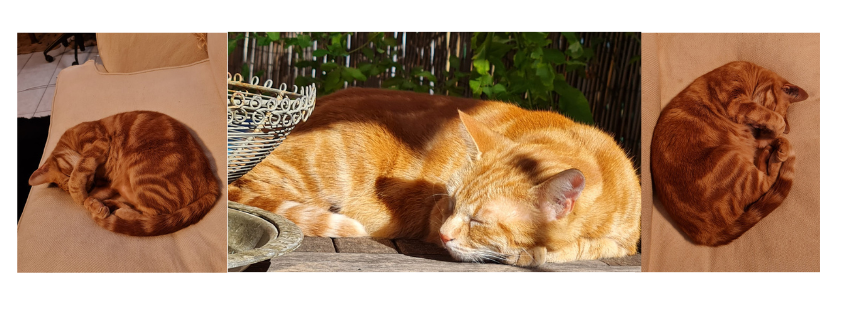
To convey an impression of her infinite capacity for enjoyment, I’m adding a few pictures.
This time I don’t have many questions for you, if only:
Do you have someone (and I count animals among these “someones”) who is able to enjoy with total abandon?
If yes, do you allow your body to resonate with this vibe?
What if there can never be too much sleep or affection? 😉
Since my last blog post, so much has happened on my journey of gathering the elements that make up MY sense of ‘home’.
And faster than expected, I’m on the move again.
How did this come about?
Through the increasingly loud voice of my body.
My last accommodation in the countryside, which had been so paradisiacal in summer, gradually transformed into a cold trap for my vulnerable system as autumn approached.
After a week’s vacation in an insulated and easily heated room, everything changed.
Suddenly, all the things that had previously required a tolerable degree of adaptation weighed infinitely heavy. I had a persistent sore throat and was constantly on the brink of sinusitis. Despite three blankets and as many layers of nightwear as possible, I could often only sleep from midnight until four in the morning, then throwing myself into motion well before sunrise. I counted the nights, dragged myself through the days… and actively searched for a solution.
I researched temporary apartments in Stuttgart, arranged viewing appointments, and set off just four days later with my Deutschland-Ticket. Simply arriving in the familiar area that connects me with my sister as well as her friends and mine was immensely comforting.
The intensive viewing weekend quickly showed, however, that this wasn’t the solution—at least not at this time. My body was quickly on the verge of illness again, and no rental contract materialized either.
But then, from a conversation with a friend, a truly fantastic turn of fate emerged—the following month, her house in the South of France would be empty for a month, and they would have to take the semi-wild cat with them to the city. If I could house-sit and cat-sit, however, everyone would be served. This was the solution! Especially since this opportunity would elegantly follow my first long-planned house-sit with friends at Schliersee.
So I broke camp, moved all my belongings into professional storage within five days, and set off after a friendly but firm farewell to the former green paradise, with a fully packed Georgia!
Georgia is my wonderfully reliable car, which I had hardly driven due to lack of occasion, which is why I was still anxious. However, the relative seclusion and fantastic rural peace of the green paradise had caused a switch to flip—suddenly driving was no longer a leisure activity, and I even temporarily began to enjoy it.
Although I still had respect for unknown and especially “longer” routes—with previous maximum drives of three hours, this limit was quickly reached for me—I still ventured into the adventure—and indeed, miraculously, arrived safely without major emotional turmoil.
In my dear friends’ house, who were departing on a long-planned trip, two four-legged housemates awaited me, whom I had already come to know and love from previous visits and classes: Kitti, the most delicate black kitten in the world, so light that I always want to put her in my handbag, and the deeply relaxed golden dog lady Gina.
At first, it was strange to inhabit my dear friends’ huge house without them, but thanks to the little animals, I wasn’t alone—quite the contrary.
Especially since a rhythm of walks soon established itself, where Gina took me out of the house three times a day for at least half an hour—not entirely easy to coordinate with my online teaching, but I managed.
She helped me, with her patient waiting and impeccable obedience, to cope with the new task—calling her to the roadside when a car comes, possibly putting her on a leash if someone might otherwise be afraid, picking up her droppings, and of course rewarding her obedience with treats.
Actually, I was supposed to be the guardian and caretaker who thought she was setting the tone, but honestly, she was coaching me. 🙂
The only highly negotiable question was how many treats she should get. And since walks also mean treats, I was nudged very often, as described above, even early in the morning.
Through Gina, I unfailingly got out into the magnificent nature, which was simply invigorating even in rain and gray skies. And soon I no longer felt strange when my conversations now also extended to my four-legged friends.
Gradually, my body released the shock of the brief but intense cold experience that had stirred up old traumas. The muscles cramped to the last fiber visibly loosened with each walk. My eyes no longer expected fleeting shadows in every corner and crevice, and being able to use hot water and heating at any time of day or night was a blessing.
I could sleep again and looked forward to my day’s work with joy.
Nevertheless, the autumn gray and darkness gradually weighed on my spirits. So I was almost as deliriously happy as Kitti and Gina about my friends’ return, even though the three of us had become a great team!
I am very grateful for this further step on my path, following the signals of my body. Strictly speaking, it had already made itself quite clear during the sale and departure from my parents’ house and had timed the process.
Admitting to oneself what truly benefits body, mind, and soul and what doesn’t, and yielding to it when possible, is an immense gift—perhaps the greatest I have ever given myself.
During this further step, I gained a wonderful insight: namely, what it feels like to be welcome in a house where I can take and use everything I want. Where people trust me so much to care for their four-legged family members that no control is necessary—especially since the question is really who is taking care of whom. What it’s like when everyone feels well cared for and simply enjoys their time in the place where they are.
This was an immense gift after years of feeling like a servant in familiar territory.
Here are my questions for you, dear reader:
Where do you feel completely welcome?
Who trusts you so much that they entrust their loved ones to you?
And—to return to the beginning of this account:
Do you give your body and its signals enough space?