Author: Corinna Kaebel

  • When the Body Shows the Way 2

    Receiving, Light and Loulou: Arriving in the South
    The Joy of Being Alive, Part I
    As announced in my last blog post, I set off for the South of France after my healing stay at Schliersee.

    This trip now was a journey that exceeded everything I had ever dared before in terms of length and unknown factors. The route covered 1200 kilometers, leading through Austria and Switzerland to France and then all the way down to the south.

    Fortunately, no left-hand traffic was involved—that would have been the last straw for me… 😉

    Following my friend’s wonderful planning, I had divided the journey into two sections, with a stopover at her husband’s place, who lives in Switzerland for work during the week. He was to provide me with additional tips and tricks for the ride.

    The drive to him took six hours—apart from breaks—and after some initial apprehension about whether I would be able to buy the vignettes in time, it was overall a fairly smooth affair. My dear friend at Schliersee had prepped me before my departure with valuable information and energetic support.

    I was amazed at how fast the Swiss drove and generally adapted to the flow, which in my perception didn’t differ much from that on German highways, just at a lower base speed.

    My shock was enormous when my friend’s husband later explained that in Switzerland, you get fined for speeding even by just one km/h. Then why was everyone driving like maniacs—at least according to Georgia’s speedometer?

    Thusly primed, I continued my journey in a cold sweat in my attempt to stick to the speed limits—which apparently made even the Swiss noticeably aggressive. Crossing into France promised relief, but only at first. The further south I got, the harsher the light became for my eyes which had already adjusted to autumn, and the more erratic the trucks’ overtaking maneuvers seemed. It was simply a terribly long drive: every three hours I needed a one-hour break, and after 11 hours I arrived at my destination completely frazzled.

    The last stretch—a winding swamp and coastal road notorious for reckless speeders and dangerous overtaking maneuvers—I should have avoided, but due to my exhaustion and fear of losing the last juice on my phone, I had ended up there anyway.

    A speeder behind me tailgated and high-beamed me so intensely that I pulled off in panic onto a tiny emergency stop which was a whole asphalt layer lower than the road and consisted primarily of the sand and rock formations typical of the region. In my haste I hadn’t noticed this. After I had calmed down somewhat—at first I was crying and hyperventilating uncontrollably—I had to get back up onto the road. When driving up over this steep edge, I felt like I was scraping Georgia’s undercarriage, and she felt as weak-chested as I was, which immediately reactivated my panic mode.

    Thank God there was an elderly couple behind me who deliberately kept their distance and used their lights to signal that no one should overtake me anymore. So I drove along crying and hyperventilating for what felt like 20 minutes, pulling a whole convoy of cars behind me, until I finally came to a stop at the entrance to the settlement… thankfully right in front of a pharmacy.

    When I got out, I was so dizzy that I had to sit down on the pavement several times. In the pharmacy, an employee helped me immensely despite my broken French, sold me a calming herbal spray, and advised me to first look for the house on foot and then drive there with the car. This advice was invaluable.

    As it turned out, I had come to a stop not far from my destination and after the little reconnaissance walk, I could indeed park dear Georgia near the house much more calmly.

    Shaken, I carried the most important things from the car into the house and called friends who immediately helped me calm down. Nevertheless, I still felt very lost and alone; I was literally still scared stiff.

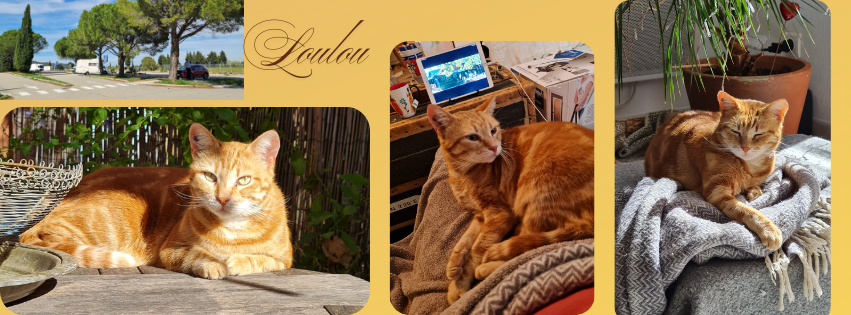
    Then suddenly a distinct meow sounded very close to me: until then, the caramel-colored Loulou had not stood out visually among the many wicker accessories in the otherwise beach-colored furnished house. Yet she had apparently been sitting patiently on the office chair the whole time, taking in the curious new arrival with all its belongings.

    Excited but friendly, she rubbed against my legs, sniffed, and soon marked everything with the corner of her mouth. She also let herself be petted surprisingly quickly—but above all, of course, she wanted her evening meal. I found this very quickly thanks to my friend’s wonderful instructions, and my rattled nerves calmed down noticeably.

    Slowly I could also perceive the great gift basket that she had prepared in the name of cat and family, and I also found my sleeping quarters.

    When I finally ate and drank again—after a day with deliberately little fluid and food intake to avoid getting too tired or having to constantly use the toilet—I noticed that much of the panic had been able to take hold precisely because of this.

    Moreover, through looking at the navigation system—which had become possible for the first time through installing my phone in my newly acquired phone holder—I had seen my actual driving speed—I was regularly below the speed on my speedometer!

    In retrospect, this meant two things:

    All the people who had overtaken me in the past with marked irritation—despite my efforts not to drive “exactly xx”—had been right: Apparently, I had constantly been driving far too slowly!

    On the other hand, there was now hope that my first day of excesses in Switzerland hadn’t been so excessive after all. Perhaps I had been driving just right…

    No wonder everyone seemed to be speeding to me!

    Nevertheless, the shock still ran deep, so I waited several days after my dramatic arrival before driving again. And when I did so, I was relieved to find that Georgia was fine. Moreover, people overall—with a few exceptions who overtake with high beams even on solid lines without visibility into the curves ahead—were driving quite leisurely. Furthermore, I now finally had an accurate speed display—which, by the way, also revealed that apparently 80 km/h is the maximum speed on country roads in France… Insights upon insights. 😉

    But now back to the wonderful cat lady who henceforth determined my stay. Her trustfulness was and is such a sweet gift that I can’t even put it into words.

    I had expected a wild cat who exclusively climbs in and out through the barred kitchen window when she wants, generally does her own thing and comes mostly for food.

    The Loulou I’m privileged to experience is trusting, affectionate, talkative, and extremely pleasure-seeking.

    In the first days I was still very cautious and once very sad when I had apparently startled her with a sudden movement: After a “trusting” night in which she had even slept on my foot, she suddenly bolted away in the morning after food and petting and hadn’t been seen since.

    My friend reassured me explaining this was normal—but in my mind old reaction patterns took hold: I surely had done something wrong and caused irreparable damage.

    When Madame Cat returned in the evening, it was as if nothing had happened, and since then I’m absolutely fine with whatever moods she displays.

    I also think I’ve figured out that this “bolting away” is a kind of ritual that she even enjoys. When I once commented on it laughingly, she paused halfway up the stairs and looked down questioningly.

    The extent of what she understands is incredible—and then again not: She is, after all, a very conscious being with wishes and preferences who reads the energy around her at all times.

    All the more grateful am I to her that she makes every day and night a pleasure for me; apart perhaps from the sometimes very early morning wake-up meows prodding me to finally give her her food.

    The longer we spend time together, the more it suffices to just think things at her to know that she knows what I mean.

    And this also applies in reverse!

    Once in the evening while watching movies—a wonderful occasion to have her on my lap and pet her extensively until she gets too warm—I pulled my plugged-in iPad closer to switch something, and she gently swiped at the cable.

    I remembered that there were special package strings for her, fetched one and waved it in front of her face. The look I received was so full of contempt, as if I had insulted her honor and intelligence. She even incredulously tilted her head and then disappeared wordlessly, or rather meow-lessly.

    Isn’t it great how once again the animal trains me and not the other way around?

    While she previously had to go through the kitchen window to get in and out of the house, she now knows what sounds to make from outside with her paws and from inside with her claws so that her devoted servant opens the house or terrace door for her to stroll through.

    But this is a “serving” that brings joy.

    And… oops, NOW I have to go feed her—the meowing has definitely become too loud and insistent by now!

    To convey an impression of her infinite capacity for enjoyment, I’m adding a few pictures.

    This time I don’t have many questions for you, if only:

    1. Do you have someone (and I count animals among these “someones”) who is able to enjoy with total abandon?
    2. If yes, do you allow your body to resonate with this vibe?
    3. What if there can never be too much sleep or affection? 😉
  • When the Body Shows the Way – 1

    Stopover at Schliersee: A Lesson in Being Welcome

    Since my last blog post, so much has happened on my journey of gathering the elements that make up MY sense of ‘home’.

    And faster than expected, I’m on the move again.

    How did this come about?

    Through the increasingly loud voice of my body.

    My last accommodation in the countryside, which had been so paradisiacal in summer, gradually transformed into a cold trap for my vulnerable system as autumn approached.

    After a week’s vacation in an insulated and easily heated room, everything changed.

    Suddenly, all the things that had previously required a tolerable degree of adaptation weighed infinitely heavy. I had a persistent sore throat and was constantly on the brink of sinusitis. Despite three blankets and as many layers of nightwear as possible, I could often only sleep from midnight until four in the morning, then throwing myself into motion well before sunrise. I counted the nights, dragged myself through the days… and actively searched for a solution.

    I researched temporary apartments in Stuttgart, arranged viewing appointments, and set off just four days later with my Deutschland-Ticket. Simply arriving in the familiar area that connects me with my sister as well as her friends and mine was immensely comforting.

    The intensive viewing weekend quickly showed, however, that this wasn’t the solution—at least not at this time. My body was quickly on the verge of illness again, and no rental contract materialized either.

    But then, from a conversation with a friend, a truly fantastic turn of fate emerged—the following month, her house in the South of France would be empty for a month, and they would have to take the semi-wild cat with them to the city. If I could house-sit and cat-sit, however, everyone would be served. This was the solution! Especially since this opportunity would elegantly follow my first long-planned house-sit with friends at Schliersee.

    So I broke camp, moved all my belongings into professional storage within five days, and set off after a friendly but firm farewell to the former green paradise, with a fully packed Georgia!

    Georgia is my wonderfully reliable car, which I had hardly driven due to lack of occasion, which is why I was still anxious. However, the relative seclusion and fantastic rural peace of the green paradise had caused a switch to flip—suddenly driving was no longer a leisure activity, and I even temporarily began to enjoy it.

    Although I still had respect for unknown and especially “longer” routes—with previous maximum drives of three hours, this limit was quickly reached for me—I still ventured into the adventure—and indeed, miraculously, arrived safely without major emotional turmoil. 

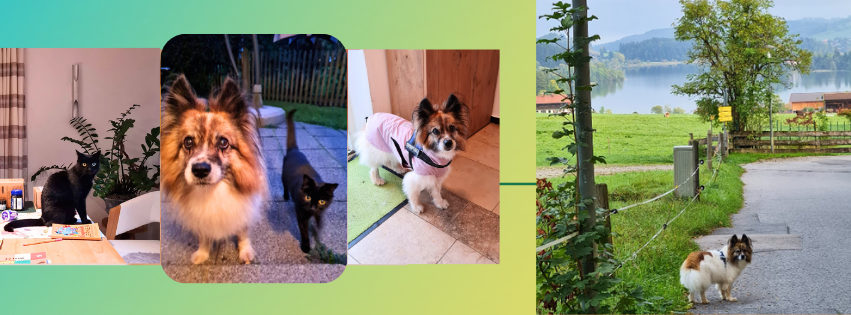
    In my dear friends’ house, who were departing on a long-planned trip, two four-legged housemates awaited me, whom I had already come to know and love from previous visits and classes: Kitti, the most delicate black kitten in the world, so light that I always want to put her in my handbag, and the deeply relaxed golden dog lady Gina.

    At first, it was strange to inhabit my dear friends’ huge house without them, but thanks to the little animals, I wasn’t alone—quite the contrary.

    Especially since a rhythm of walks soon established itself, where Gina took me out of the house three times a day for at least half an hour—not entirely easy to coordinate with my online teaching, but I managed.

    She helped me, with her patient waiting and impeccable obedience, to cope with the new task—calling her to the roadside when a car comes, possibly putting her on a leash if someone might otherwise be afraid, picking up her droppings, and of course rewarding her obedience with treats.

    Actually, I was supposed to be the guardian and caretaker who thought she was setting the tone, but honestly, she was coaching me. 🙂

    The only highly negotiable question was how many treats she should get. And since walks also mean treats, I was nudged very often, as described above, even early in the morning.

    Through Gina, I unfailingly got out into the magnificent nature, which was simply invigorating even in rain and gray skies. And soon I no longer felt strange when my conversations now also extended to my four-legged friends.

    Gradually, my body released the shock of the brief but intense cold experience that had stirred up old traumas. The muscles cramped to the last fiber visibly loosened with each walk. My eyes no longer expected fleeting shadows in every corner and crevice, and being able to use hot water and heating at any time of day or night was a blessing.

    I could sleep again and looked forward to my day’s work with joy.

    Nevertheless, the autumn gray and darkness gradually weighed on my spirits. So I was almost as deliriously happy as Kitti and Gina about my friends’ return, even though the three of us had become a great team!

    I am very grateful for this further step on my path, following the signals of my body. Strictly speaking, it had already made itself quite clear during the sale and departure from my parents’ house and had timed the process.

    Admitting to oneself what truly benefits body, mind, and soul and what doesn’t, and yielding to it when possible, is an immense gift—perhaps the greatest I have ever given myself.

    During this further step, I gained a wonderful insight: namely, what it feels like to be welcome in a house where I can take and use everything I want. Where people trust me so much to care for their four-legged family members that no control is necessary—especially since the question is really who is taking care of whom. What it’s like when everyone feels well cared for and simply enjoys their time in the place where they are.

    This was an immense gift after years of feeling like a servant in familiar territory.

    Here are my questions for you, dear reader:

    Where do you feel completely welcome?

    Who trusts you so much that they entrust their loved ones to you?

    And—to return to the beginning of this account:

    Do you give your body and its signals enough space?

  • What Are My Feelings Telling Me?

    Is everything I feel relevant? The subtle but crucial difference

    Do you know this feeling – you wake up in the morning, and while you’re still in that twilight state, the familiar worries, big and small, slowly but surely flow into your consciousness?

    Yet yesterday evening everything had been so beautiful, and you had gone to bed with a feeling of elation, determined to approach the new day “positively”!

    So now, on top of the already unpleasant feeling, comes the annoyance with yourself for having “tipped over” again.

    Do you notice something?

    At least I notice a clear tendency, almost cruel in its exclusiveness, to always want to strive for absolute happiness – or even feel obligated to do so.

    If you’re not happy, something’s wrong with you.

    I have several very different questions about this:

    • Isn’t it okay, given everything that’s constantly happening in the world, to sometimes not be manically happy – even if you’re among the fortunate ones who don’t live under immediate threat?
    • What if your happiness looks completely different from what is commonly defined as such? Quieter, more relaxed, with more room for various sensations?
    • What if you can easily let go of that heaviness that does not belong to you?

    Everyone will think differently about my first question – but surely everyone will admit that paradise doesn’t reign on earth. Why else would religions, spirituality, philosophy etc. exist? They ultimately serve to cope with “this life,” to understand its meaning, to either explain the unpleasant, the suffering, view it from a different angle, or reduce it. The central question for me is: How do I deal with the fact that suffering exists? I strive to live as honestly as possible and to open up space for happiness in my encounters with others, as best I can.

    This brings me to my second question: What is happiness for you personally, in your sphere of influence? Where do you find yourself in this particular situation?

    My happiness consists of being able to perceive and feel things, but then also being able to switch back into that spaciousness that allows me to continue breathing and see other possibilities. This also includes phases where I consciously surrender to melancholy, sadness, grief. Times I allow myself when I don’t have to sugarcoat or reinterpret anything, when I let my feelings and sometimes tears flow freely. Interestingly, these phases pass all the more quickly the kinder I am with myself and allow everything – often it’s a matter of just a few minutes.

    Only dwelling in foreign suffering that one cannot alleviate drags one down in the long run and doesn’t help anyone.

    But how do I recognize when I’m dealing with my own feelings?

    As a rule of thumb, I can say: If familiar thought loops attach themselves to the feelings, or entire thought constructs unfold in no time, the longer I try to “get rid of” the feeling, it’s rather an energy from outside: I perceive it and try to make sense of it, to justify it by walking down familiar mental pathways.

    An example from this morning: “The week begins. Oh no, I still haven’t found a new additional job. I’m a loser, an outcast, a parasite, I’m going to waste my parents’ money too, I’ve always been a failure…” Viewed soberly, I could refute every single “point,” but that’s precisely the crux – that in such moments one doesn’t think “soberly.” Instead, the brain “thinks” all fitting associations from one’s own experience toward the perceived energy. Following the motto: “I feel …, this must come from the fact that I did or didn’t do …, am or am not … etc.” At the end of such thought chains, I feel even worse and see no way out. This is the clearest sign that it’s an energy from outside that I cannot change because it’s not mine.

    In summary – feelings from which long thought chains unfold that lead to hopelessness are usually not mine.

    But how do my own feelings differ?

    Here’s an example from my not-so-distant past: In the last two years, since I became the last remaining person from my family, without having founded one of my own, especially during travels I was overcome by the realization that I currently have no one in the world waiting for my updates. While I had previously sometimes experienced this “having to report” as an unpleasant burden, the new “freedom” was initially anything but pleasant. It was a feeling of aloneness that went so deep that my head couldn’t even engage, and as soon as I (finally!) stopped suppressing it, it broke through and discharged itself, in this case in healing tears.

    Or a situation annoys me that I initially try to talk myself into liking. However, if I give free rein to the anger by, for example, consciously grumbling to myself and also physically releasing the tension, clarity suddenly emerges. And afterward I might even start singing.

    The difference between foreign suffering that we perceive and unsuccessfully try to resolve — our head runs hot but comes to no conclusion – and our own feelings that discharge when we give them space, has been a vital realization for me.

    How are you doing?

    Do you struggle with “troublesome feelings”?

    What if we can handle everything if we just approach it consciously?

    I wish you a wonderful, diverse, and conscious day!

  • Bye-Bye Bothmerstraße!

    Bye-Bye Bothmerstraße!

    Looking out over the garden in front of my family’s house that has been passed on from my grandparents to my parents, then from my parents to my sister and me, and ended up in my hands after my sister’s passing almost two years ago, I am grateful and happy to soon be leaving it for good, to a wonderful young family. And to go out into the world, once again!

    Over a period of seven years when first my father, then my mother, and finally my sister passed, I have come to periodically live in this house, with varying extents of gratitude, to be honest. There’s so much more upkeep involved in a house with a garden than I am used to as a work nomad taking up residence wherever life leads me. Moreover, the circumstances necessitating my presence – revolving around clearing out the house over the years, trying to provide support to my family in sickness and death, making it a haven for my sister and me after our parents’ passing – were not exactly joyful. Nevertheless, I am very grateful to the house and especially the garden for providing me with an oasis of peace when I most needed it.

    But now the time has come to move on.

    And although all those years I simply HAD to take sorting through my family’s belongings might seem excessive to some, I hope that my experience – as it will most probably play out in this blog – will be a contribution to some readers. Just reading about how other people experience a similar situation can already bring the relief of knowing you’re not alone.

    So today I am starting off my blog Bye, bye Bothmerstraße! with a short spin through time.

    So what did the house mean to me over the years?

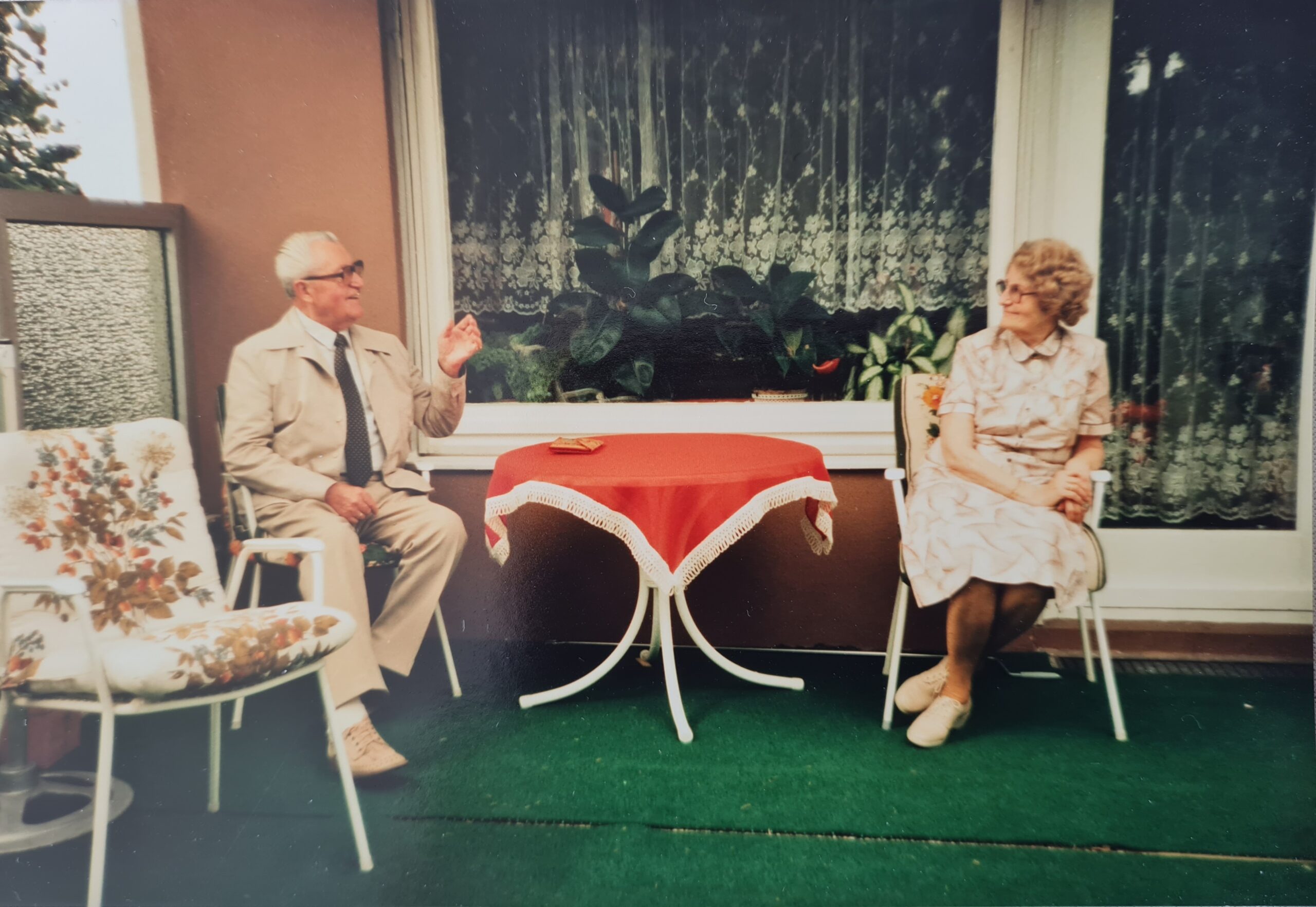
    Starting in the 80ies and 90ies, it was my grandparents’ home whom we visited on Easter and New Year’s Eve. They would move their 50ies-style metal garden furniture with flowered covers and a wax table cloth out onto a stretch of artificial grass to proudly sit on their veranda. The interior, with its plush u-shaped sitting corner complete with mirror and wooden lions, was more reminiscent of a Victorian style but could easily be complemented with said garden chairs if need be. Classic snacks were being offered – such as jelly-filled donuts called Berliner, and mustard eggs – but my grandparents also made concessions for the younger generation by putting out peanut flips and pretzels. One of the culinary highlights for me was the so-called Gelbwurst, basically weisswurst in the form of cold cuts, a regional specialty. Today, I wonder how 7 adults could sleep in a 100 square foot home – but apparently, we managed.

    I also remember the winters having a magical touch to me, as they were cold and there was actual snow (!), especially in comparison to rainy Northern Germany where my parents and me lived at that time. And in spring and summer, squirrels running up and down the trees and around the neighborhood were always a special treat to me. All in all, I had pleasant associations with the house back then, as the place my grandparents lived.

    Later, when they moved into a living unit in an old people’s home they had been reserving for years in advance, my parents moved into the house. Now they were separated by just a 10-minute drive. As my father’s retirement coincided with my graduation from high-school I had time to help my parents move, and then set out to go to university.

    I remember my sister and me having lots of fun helping our father nail down tar paper on the garage roof, and seeing my parents transform the living space to their taste and liking. They added a winter garden at the back of the house, and a tiny sunroom extension in the front – which, funnily enough, is associated with another very enjoyable memory of helping hands-on – namely in breaking down the wall with hammers!

    Afterwards, there were family gatherings over a period of almost thirty years, and the rooms in the house taking on different functions. Most notably, my sister and me would always sleep in the second-tiniest room of the house in the basement, with a folding bed crammed in, but that’s where we could talk into the wee hours without disturbing anyone – and also enjoy the sweets our father secretly snuck in for us.

    All in all, in my mind, the house was reserved for family feasts and family get togethers – which in our case would be our nuclear family consisting of our parents, my sister and me.

    Notwithstanding all my hunger for freedom and travel it provided a sense of emotional stability I certainly didn’t fully appreciate at the time. Moreover, I could still leave stuff – like my children’s books and toys, but also more recent items, “at home”. And the attic provided an ample choice of furniture to populate my student’s abodes with. I remember at one time taking a hoover on my train ride back to Leipzig, much to the amusement of the other passengers.

    The house in Nuremberg was the place I could and would find my parents without fail – and although our family dynamics weren’t exactly easy and I always had to brace myself for those visits and recuperate afterwards, there was this bedrock quality I’ve come to appreciate only recently.

    Later, as our parents started aging, the house saw a lot of pain, suffering, intensifying of detrimental personality traits and hard talks. And yet, as far as possible, the family tradition of gathering to talk or play were being upheld, even after our father died 7 years ago. Our mother followed him a little over a year later, and up until my sister passed, I’d arrange for us to celebrate Christmas and New Year’s at the house in a fashion that reminded us of the bigger family gatherings of the past.

    Once, my sister jokingly said to me she could picture me as an old lady sitting in the living room with some knitwork on my lap, looking out over the garden – which, at the time, elicited but horrified protest from me.

    But today, I am looking out of the window and enjoying every bird (or cat) that comes to visit, in delightful anticipation of leaving it all behind and in good hands very soon.

    I wonder how life will unfold for the new owners here – and what stories the house will have to tell then?

    In conclusion to this introduction, I would like to give you some questions around the concept of “home”.

    How you have experienced your parents’ house – if there has been one in your life, of course?

    Or, to put it more broadly, where have you experienced or placed “home”?

    Is there one place in particular or are there several places – or people – or states of mind – which hold that quality for you?

    How important is a sense of home to you?

    And how grateful would you allow yourself to be for all the instances of home you experience?